AI adoption for Irish business
You bought the licences. Nothing changed.
Most organisations have now paid for AI and changed almost nothing about how the work gets done. We find where your hours actually go, work out which assistant fits that work, then implement it and train your people on their own files.
- Where
- Ireland and the UK
- Who it is for
- 20 to 500 people
- Assistants covered
- Claude · Copilot · ChatGPT
- Delivery
- Led by Ger, run by a trained bench
Any of this sound familiar
The licences went out to everyone. The usage reports are not something you would show the board.
People sat through a session, said it was useful, and changed nothing by Monday.
Nobody can tell you who genuinely needs the premium seat, so everyone got one.
The board pack still takes two days a month.
Half the organisation is quietly using a free tool you never approved.
The people who would benefit most are the ones who have not touched it.
None of that is a tool failure. It is what happens when capability is bought centrally and never matched to anyone’s actual week.
The tool is rarely the problem. The match between tool and work is.
€531,000
understated, and it looked fine
One assistant reported a regional revenue total short by that much, because a location name was spelt three ways in the source data. The output was a neat sorted table.
39 → 3
hours a month, one finance function
The gain came from redesigning the reporting cycle and removing three manual consolidation steps. Not from prompting harder.
8 of 10
chose checking over every feature
Offered a full menu of capabilities, eight of ten people at one professional services firm picked the discipline of checking the answer.
Every figure here is from a real engagement and can be sourced. We do not publish a headline percentage we could not defend live, in the room, in front of the people who generated it.
Four stages, and the first two are where the money is saved.
01 · ASSESS
Which assistant, for whom
We read your help-desk traffic and your own data before anyone writes a curriculum. The largest programme we run changed direction twice on what that diagnostic said.
02 · TARGET
Which work to point it at
Demand is uneven and sometimes absent. We find where the hours actually go rather than assuming the answer generalises from one team to the next.
03 · IMPLEMENT
Inside your licences and approved tools
The licence position is settled before the session, so nothing gets demonstrated that the room cannot use on Monday. Nothing off the approved list gets named.
04 · TRAIN
On your files, by department
Rules built, templates saved, folders created, prompts written against real documents, manager in the room. If nothing is different by lunchtime, the session failed.
Doing it this way produces something no generic course can. You find out who actually needs the expensive licence, and everyone else finds out first-hand that the tier they are on does the job.
We group the work the way your week is grouped, not the way a product catalogue is.

Shared and high-volume mailboxes
Routing rules, two-click acknowledge and file, then summarising a thread you joined late. A good share of this runs with no AI licence at all.
Investigation and report writing
Templates and consistent styles first, because the assistant cannot rescue an inconsistent document. Then drafting, redrafting and version comparison.
Caseload and finance data
Text sitting in numeric columns, three spellings of one location. Where a figure has to reconcile, the deterministic tool is the safer instrument.
Management and board reporting
One energy investment firm was losing two days a month to the board pack. The work is in restructuring the cycle, not in better prompts.
Meetings and minutes
Actions and owners extracted. Then compare what was discussed against what the meeting was constituted to cover. One organisation found it never reached half its agenda.
Document retrieval and storage
Asked how they would find a document from three months ago, more people said “search my email for the attachment” than gave any other answer.
The checking habit
Take a 220-page standards document, ask for the core principles, watch it invent one. Run it ten times, it invents a different one each time. Nobody argues afterwards.
Standing daily workflows
A chief executive runs a scheduled prompt at 6pm that delivers a prioritised digest before the laptop opens. Every room shown it has asked for it.
Most of the blocker turns out to be people and process.
Habits and people generated more discussion than every technology topic combined. The questions were about whether staff felt they had permission to work differently.
Spreadsheet work drew zero picks from ten people at one firm, and was the top priority at another. Ask before assuming.
The content comes from your data
A hyperscaler course is written once for everybody, which is why it is free and why it cannot tell a regulatory investigator from a claims handler.
600 to 700 polling data pointsData runs before, during and after
A diagnostic sets the content. Live polling steers the room while the session is still running. A later module checks what survived.
Retention held at five weeksWe train on all three assistants
Claude, Microsoft Copilot and ChatGPT. That is what makes “which of these, for which work” an answerable question rather than a sales objection.
No vendor certificationThe independence is commercial
No reseller margin, no partner tier, no referral fee. That is what makes “you probably need fewer licences than you have bought” a sentence we are free to say.
Structurally unavailable to partnersFour formats. Most organisations start at the top and work down.
| Format | Length | Who is in the room | What happens | |
|---|---|---|---|---|
| Leadership or board session | Half day, or 2.5 hours | Directors and senior leadership | Scene setting, structured breakouts, live polling, take-away artefacts. CPD-accreditable where the host body accredits. | Most common start |
| Departmental working session | Two to three hours | One team, grouped by workload | Hands-on, on their own files, manager in the room so commitments are made in front of the people who hold them. | The core unit |
| Modular series | Recurring working morning | Pilot or leadership cohort | Each module rebuilt from the last one's feedback. This is the shape a whole-organisation rollout takes. | Rollout shape |
| Power-user deep dive | Half day | Narrow group, end of the funnel | For the people who will carry it once we leave. Runs last, never first. | Final stage |
We do not certify people against a vendor curriculum, resell licences, take referral revenue, or demonstrate capabilities the room does not have licences for.
Ger designs it. A trained bench delivers it.
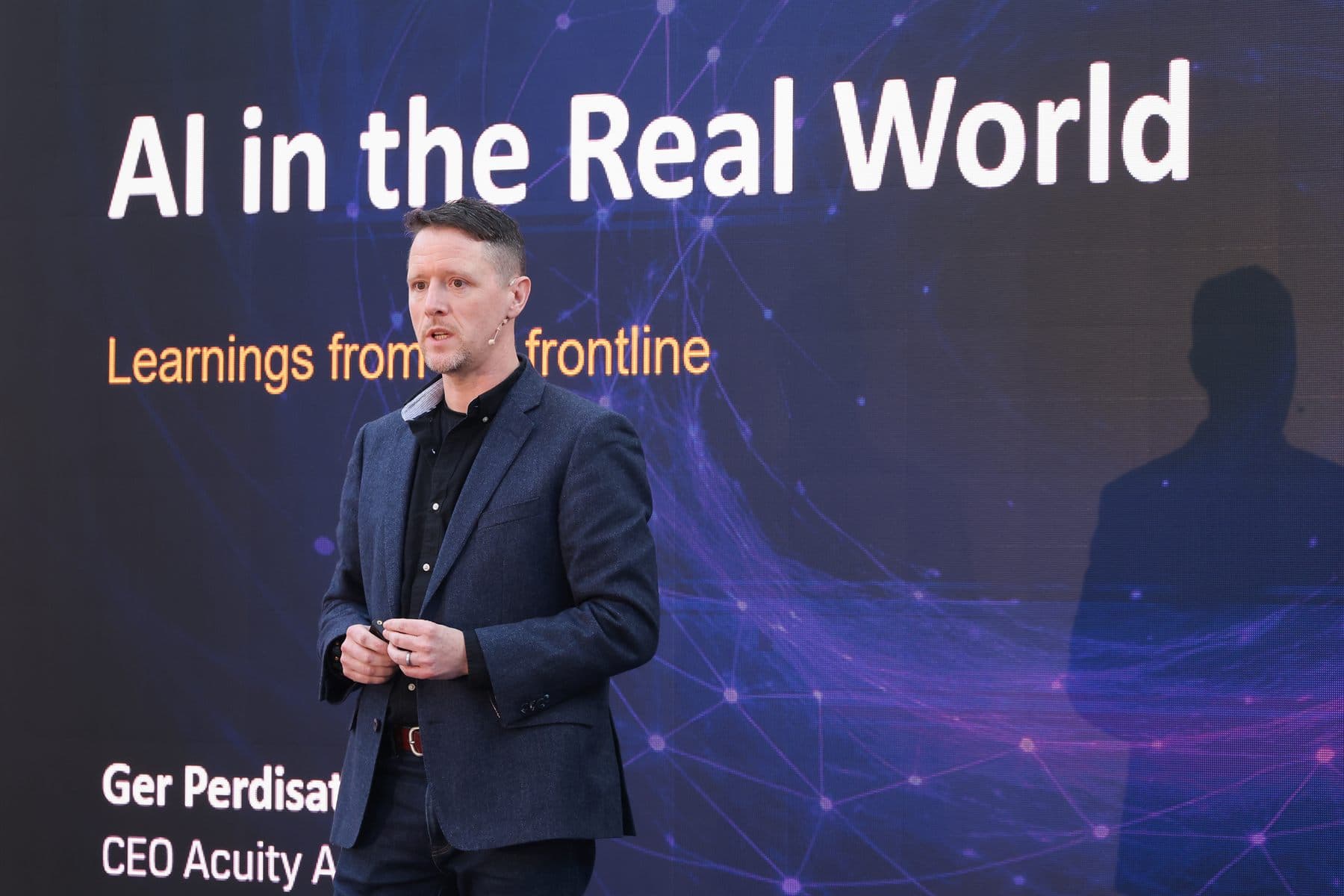
Ger Perdisatt is a former COO of Microsoft Western Europe, non-executive director of two state bodies and an ISO/IEC 42001 Lead Auditor. Three frameworks developed in this work have been adopted into a national director education programme.
Ger designs and leads
The diagnostic, the programme design, the leadership and board sessions, and the licensing conversation. That part does not get delegated.
A trained bench runs the volume
Departmental sessions are delivered by facilitators trained on our material and our data. Same content, same polling, same artefacts, several rooms in the same week.
Rollouts run in parallel, not in a queue
One anchor client is putting a whole organisation through the first two modules inside twelve months, in cohorts of 16 to 20, alongside a 40-person directorate rollout.
Start a conversation
Tell us what your people are stuck on.
No qualification maze. If a half-hour call tells you the answer is to change a storage policy rather than buy anything, that is a useful half hour and we will say so.
hello@which-ai.ieGer Perdisatt · Acuity AI Advisory · Dublin